6 Free Excavation and Trenching Safety Articles
Excavation and trenching safety is the set of protective systems, inspections, and safe work practices that keep workers from being injured or killed when they dig or work in and around excavations. Cave-ins pose the greatest risk, because a collapsing trench wall can bury a worker in seconds and a single cubic yard of soil can weigh as much as a small car. Other serious hazards include falls, hazardous atmospheres, water accumulation, contact with underground utilities, and being struck by mobile equipment or falling loads.
The excavation and trenching safety articles on this page explain these hazards and how to control them, grounded in OSHA's excavation requirements. They cover calling 811 to locate buried utilities before any dig, the protective systems that guard against cave-ins, essential trenching and excavation practices, the specific OSHA standards that apply to this work, and the safe operation of horizontal directional drilling. They also make clear that workers have the right to cave-in protection whenever they enter a trench.
Foremen and safety managers can use these articles to review a hazard before breaking ground, train a crew that digs or works near excavations, or prepare for a safety meeting. They are written for excavation and utility contractors, competent persons, foremen, and safety managers responsible for anyone working in or near a trench.
Why it matters
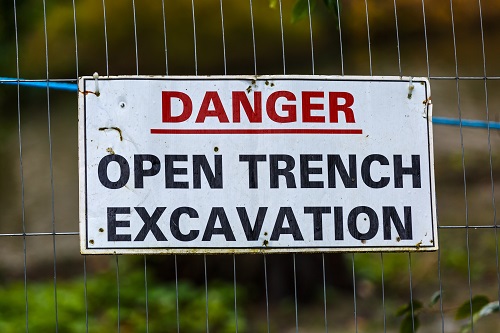
Cave-ins can happen without warning and are one of construction’s deadliest hazards.
Excavation and Trenching Safety Articles


Excavation and Trenching FAQs
When does OSHA require a protective system in a trench?
OSHA requires cave-in protection in any trench 5 feet deep or more, unless the excavation is made entirely in stable rock (OSHA 1926.652). Trenches shallower than 5 feet can still need protection when a competent person sees signs of a possible cave-in, and any excavation 20 feet deep or more must use a protective system designed by a registered professional engineer.
What are the main ways to protect workers from a cave-in?
The four protective methods are sloping, benching, shoring, and shielding. Sloping cuts the trench walls back to a safe angle, benching cuts them into steps, shoring uses supports such as hydraulic jacks to hold the walls in place, and shielding uses a trench box to protect workers if the walls collapse.
Do you have to call 811 before digging?
Yes, you must call 811 before digging. Calling a few days before breaking ground has utility owners mark the approximate location of buried gas, electric, water, and communication lines at no cost. It is required under state one-call laws and is a basic step before any excavation, no matter how shallow.
How often must an excavation be inspected?
A competent person must inspect the excavation, the adjacent areas, and the protective systems daily before work starts and as conditions change through the shift. Inspections are also required after rainstorms or any other event that increases hazards. Work stops until the competent person corrects the problem.
What is a competent person on an excavation?
A competent person is someone with the training and the authority to identify existing and predictable excavation hazards and to correct them right away. On excavation work they classify the soil, select and oversee the protective systems, and perform the required inspections.
How should workers safely enter and exit a trench?
Workers should enter and exit a trench by a safe means of access, never by climbing the walls or the shoring. In trench excavations 4 feet deep or more, OSHA requires a ladder, ramp, stairway, or other safe means of exit within 25 feet of every worker (OSHA 1926.651). This lets a worker climb out quickly if the trench starts to fail.