Workers doing activities in and around trenches and excavations must be alert to the real possibility of a trench cave-in. In most situations, a cave-in is likely to happen if there is no protection and workers should be aware of the specific type of protection they need to keep them safe while working in a trench or excavation. Workers die every year when they are caught in an excavation or trench cave-in.
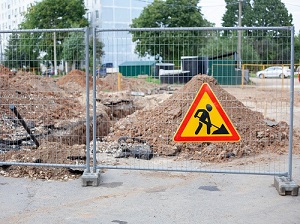
Excavation Safety Rules
The FIRST RULE is to never enter an unprotected excavation or trench!
All excavations and trenches must be inspected by a Competent Person before workers enter them.
Excavations more than 5 feet deep must have cave-in protection.
A safe way to enter the excavation or trench is required when it is 4 feet or deeper.
OSHA Standard 1926.652(a)(1) Each employee in an excavation shall be protected from cave-ins by an adequate protective system designed in accordance with paragraph (b) or (c) of this section except when: (i) Excavations are made entirely in stable rock; (ii) Excavations are less than 5 feet (1.52 m) in depth and examination of the ground by a competent person provides no indication of a potential cave-in.
Before workers enter any excavation or trench it must be inspected by a Competent Person and there must be protection from a potential cave-in.
Cave-in Prevention Systems
Cave-in protection can be provided using an approved protective system designed to reduce the risk of soil collapse and protect workers inside the excavation. The type of system used depends on factors such as soil classification, excavation depth, nearby structures, water conditions, available space, and the work being performed. A competent person must evaluate site conditions and determine the appropriate protective method.
Sloping System
Sloping is a method of cave-in protection that involves cutting back the sides of an excavation at an angle inclined away from the trench or excavation to reduce the risk of soil collapse. The proper slope angle depends on the type and stability of the soil. More stable soil may allow steeper slopes, while less stable soil requires a gentler angle. Sloping requires enough surrounding space to safely excavate the sides and may not be practical in areas with limited room, nearby structures, or roadways.
Benching System
Benching is a method of cave-in protection where the sides of an excavation are cut into a series of horizontal levels or steps. These steps help reduce pressure on the excavation walls and decrease the likelihood of soil collapse. Benching is not permitted in all soil types and configurations and must be designed according to soil classification and excavation conditions. The width and height of benches should follow regulatory requirements and site-specific safety procedures.

Shield System
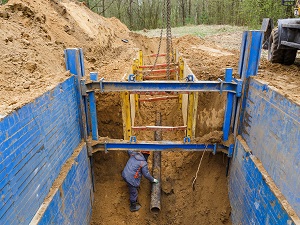
A shield, like a trench box, is a protective structure placed inside a trench to protect workers if a cave-in occurs. Unlike sloping or shoring, trench boxes do not prevent a collapse but are designed to withstand soil forces and protect workers inside the shielded area. Trench boxes are commonly used in utility work and can be effective in many soil conditions when properly selected and installed. Workers must remain inside the protected area of the box, and installation, movement, and use must follow the manufacturer’s specifications and be performed by trained personnel.
Shoring System
Shoring is a protective method that supports the walls of an excavation to help prevent soil movement and cave-ins. Shoring systems may include hydraulic, pneumatic, timber, or mechanical supports designed to hold the excavation walls in place. These systems are often used where sloping or benching is not practical due to limited space or nearby structures. Shoring must be properly installed, inspected, and maintained to ensure it remains effective throughout the excavation work.
.jpeg)

