Falls remain one of the leading causes of serious workplace injuries and fatalities. A personal fall arrest system is designed to protect workers when a fall cannot be prevented, but every component of that system must function correctly when it is needed. A damaged lanyard, defective self-retracting lifeline (SRL), worn connector, or deployed shock absorber can prevent the system from performing as intended during a fall.
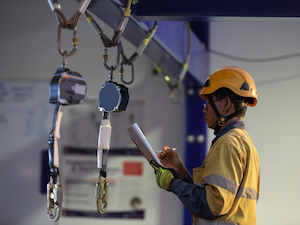
Lanyards and SRLs should be inspected before every use. In both construction and general industry, OSHA requires personal fall protection equipment to be inspected before use and that defective components be removed from service. While a quick visual inspection only takes a few minutes, it can identify problems that might otherwise go unnoticed until it is too late.
This article explains how to inspect lanyards and self-retracting lifelines, common defects to look for, and when equipment should be removed from service.
What Are Lanyards and Self-Retracting Lifelines?
Lanyards and self-retracting lifelines are connecting devices used as part of a personal fall arrest system. They connect a worker’s full-body harness to an approved anchorage or anchorage connector.
A lanyard is typically a fixed-length connector made from webbing, rope, or cable. Many fall arrest lanyards include an energy absorber designed to reduce the forces placed on the worker during a fall.
A self-retracting lifeline (SRL) performs the same basic function but operates differently. The lifeline extends and retracts automatically as the worker moves. If a fall occurs, the internal braking mechanism is designed to lock quickly and help stop the fall while limiting free-fall distance.
Although both devices are designed to help protect workers from falls, each has different inspection points and should always be inspected according to the manufacturer’s instructions for that specific model.
OSHA Inspection Requirements
OSHA requires fall protection equipment to be inspected before use.
OSHA Construction Standard 1926.502(d)(21) Personal fall arrest systems shall be inspected prior to each use for wear, damage and other deterioration, and defective components shall be removed from service.
OSHA Standard 1910.140(c)(18) Personal fall protection systems must be inspected before initial use during each workshift for mildew, wear, damage, and other deterioration, and defective components must be removed from service.
Many employers require documented periodic inspections of fall protection equipment, often performed annually, in accordance with manufacturer instructions and their fall protection program.
Why Every Inspection Matters
Fall protection equipment is often exposed to conditions that can reduce its strength or affect how it operates. Sunlight, moisture, chemicals, dirt, welding sparks, sharp edges, rough surfaces, and everyday handling can all contribute to wear over time.
Some damage is obvious, such as torn webbing or a bent connector. Other defects are much harder to recognize, including worn stitching, internal damage to an SRL, weakened fibers, or a shock absorber that has already deployed.
Equipment should never be used simply because it “looks okay” from a distance. Every inspection should be deliberate and thorough.
Before using any lanyard or SRL, confirm that:
- The equipment is appropriate for the job.
- Labels are present and readable.
- The equipment appears complete and unmodified.
- Connectors function properly.
- There are no obvious signs of damage or excessive wear.
If anything raises doubt about the condition of the equipment, it should not be used.
How to Inspect a Lanyard
A pre-use inspection should include every part of the lanyard, not just the webbing or rope. Damage can occur anywhere along the assembly, including the connectors, stitching, attachment points, labels, and shock absorber.
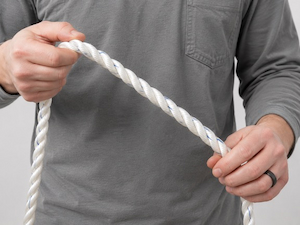
Begin by holding the lanyard so you can inspect its entire length. If it is made from webbing, slowly bend the webbing into a “U” shape as you move your hands from one end to the other. This helps expose cuts, broken fibers, damaged stitching, and other defects that may not be visible when the webbing is lying flat. Rope and cable lanyards should also be examined over their full length by looking and feeling for signs of damage.
During the inspection, verify that:
- All required labels are present and readable.
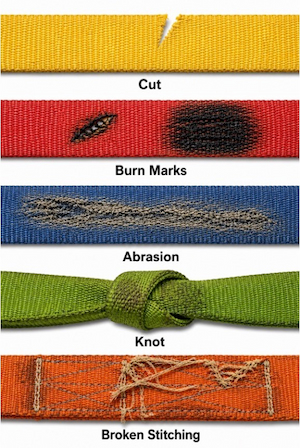
- There are no cuts, burn marks, abrasions, kinks, knots, frayed areas, broken strands, or broken stitching.
- There are no signs of excessive wear, chemical damage, heat damage, or unauthorized modifications.
- Attachment points are secure and free of damage.
- Snap hooks, carabiners, and other connectors are free of cracks, corrosion, sharp edges, distortion, or excessive wear.
- Gates fully close and locking mechanisms operate properly.
- There are no loose, missing, or damaged components.
Even minor damage can reduce the strength of a lanyard. If you find any condition that could affect its performance, remove it from service until it has been evaluated according to the manufacturer’s instructions.
Inspecting Shock-Absorbing Lanyards
Many fall arrest lanyards contain an energy absorber designed to reduce the forces transmitted to the worker during a fall. This component is intended to deploy during a fall arrest and is generally designed for one-time use.
In addition to inspecting the lanyard itself, carefully examine the shock absorber.
Check the Shock Absorber for Damage
When inspecting a shock absorber confirm that:
- The protective cover is not torn or damaged.
- There are no loose, broken, or damaged stitches.
- The shock absorber has not deployed.
- There is no damage where the shock absorber attaches to the lanyard.
- Labels are present and readable.
- There is no evidence the lanyard has been involved in a fall.
A deployed shock absorber often shows obvious signs that it has activated, such as extended webbing or torn stitching designed to absorb energy. If there is any indication that the shock absorber has deployed, the lanyard should be removed from service immediately.
How to Inspect a Self-Retracting Lifeline (SRL)
A self-retracting lifeline contains internal mechanical components in addition to the lifeline itself. While the internal braking system cannot usually be inspected by the user, several important checks can help determine whether the SRL appears to be functioning properly before use.
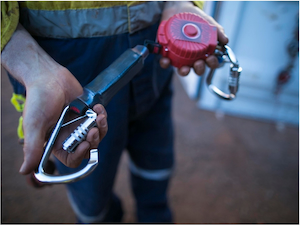
Begin by inspecting the exterior of the unit.
Inspect the Housing
The housing protects the internal braking and retraction mechanisms. The self-retracting lifeline housing should not have cracks, dents, corrosion, loose fasteners, missing hardware, signs of impact damage, or unauthorized modifications.
If the housing has been damaged, the internal components may also have been affected, even if they are not visible.
Inspect the Lifeline
Inspect the entire exposed length of the lifeline.
Depending on the type of self-retracting lifeline you are inspecting, you want to be looking for cuts, burn marks, abrasions, kinks, frayed fibers, broken stitching, broken wires or separated strands on cable lifelines, corrosion, and any other damage.
Also verify that all labels remain attached and legible.
Test the Retraction and Locking Functions
Allow the lifeline to extend and retract according to the manufacturer’s instructions.
The lifeline should extend smoothly and retract fully without hesitation, binding, or excessive slack.
Next, test the locking mechanism using the procedure recommended by the manufacturer. The braking mechanism should engage quickly and consistently. If the SRL does not retract properly or fails to lock as intended, remove it from service immediately.
Finally, inspect all snap hooks, carabiners, swivels, and other connectors for damage, wear, corrosion, distortion, or malfunction. Confirm that all gates fully close and locking mechanisms operate correctly before using the SRL.
Common Damage That Requires Removal from Service
A lanyard or self-retracting lifeline should never be used if it fails inspection or shows any condition that could affect its ability to perform safely. Continuing to use damaged fall protection equipment places the worker at unnecessary risk and can lead to equipment failure during a fall.
Common reasons to remove a lanyard or SRL from service include:
- Cuts, tears, frayed fibers, broken wires, or damaged stitching
- Burn marks, chemical damage, or heat damage
- Cracks, corrosion, distortion, or excessive wear on connectors or hardware
- Snap hooks or carabiners that do not fully close or lock
- Missing, damaged, or unreadable labels
- Unauthorized repairs or modifications
- A deployed shock absorber
- An SRL that does not extend, retract, or lock properly
- Missing or damaged components
When in doubt, remove the equipment from service. Never assume that minor damage is acceptable simply because the equipment has not failed.
What to Do After a Fall
OSHA requires that personal fall arrest equipment subjected to impact loading be removed from service immediately.
OSHA Standard 1926.502(d)(19) Personal fall arrest systems and components subjected to impact loading shall be immediately removed from service and shall not be used again for employee protection until inspected and determined by a competent person to be undamaged and suitable for reuse.
Even if the equipment appears undamaged, the forces generated during a fall can damage components that are not visible during a routine inspection. Connectors may become distorted, webbing or cable may lose strength, and internal components of an SRL may no longer function as designed.
OSHA General Industry Standard 1910.140(c)(17) A personal fall protection system or its components subjected to impact loading must be removed from service immediately and not used again until a competent person inspects the system or components and determines that it is not damaged and safe for use for employee personal fall protection.
Equipment that has arrested a fall should not be returned to service until a competent person has inspected it and determined that it is undamaged and suitable for reuse. Some manufacturers require certain equipment, particularly self-retracting lifelines, to be returned to the manufacturer or an authorized service center for inspection and recertification after a fall. Always follow the manufacturer’s instructions for the specific model being used.
Compatibility Is Just as Important as Condition
A thorough inspection does little good if the equipment is not compatible with the rest of the fall protection system.
OSHA requires connectors to be compatible with one another and prohibits certain unsafe connections that could allow accidental disengagement, commonly referred to as “rollout.” Before using any lanyard or SRL, verify that it is designed to work with the harness, anchorage connector, and anchorage being used.
Also confirm that the selected equipment is appropriate for the job. Consider factors such as:
- Required fall clearance
- Maximum arresting distance
- Swing fall hazards
- Sharp edges that could damage the lifeline
- The manufacturer’s intended use
Using incompatible components or connecting equipment in ways not permitted by the manufacturer can compromise the effectiveness of the entire fall protection system.
Common Inspection Mistakes
Even experienced workers can overlook problems when inspections become routine. Taking a few extra moments to inspect the equipment carefully can help identify defects before they become a serious hazard.
Some of the most common inspection mistakes include:
- Looking only at the webbing while ignoring the connectors and hardware
- Failing to inspect the entire length of the lanyard or lifeline
- Overlooking worn or damaged stitching
- Ignoring missing or unreadable labels
- Not testing the SRL’s retraction and locking functions according to the manufacturer’s instructions
- Assuming a coworker has already inspected the equipment
- Continuing to use equipment because the damage “doesn’t look that bad"
A pre-use inspection should never be treated as a quick glance. It is an important part of using fall protection safely and should be performed every time the equipment is used.
Frequently Asked Questions
The following answers address some of the most common questions about inspecting lanyards and self-retracting lifelines. Always refer to your employer’s fall protection program and the manufacturer’s instructions for equipment-specific requirements.
How often should a lanyard or SRL be inspected?
OSHA requires personal fall protection equipment to be inspected before each use. Many employers also require documented periodic inspections as part of their fall protection program in accordance with manufacturer instructions.
Can I use a lanyard if it has a small cut or abrasion?
No. If a lanyard shows cuts, excessive abrasion, broken stitching, or other damage that could affect its strength or performance, it should be removed from service.
What if the labels are missing?
Labels provide important information such as the manufacturer, model, warnings, and inspection requirements. If required labels are missing or unreadable, follow the manufacturer’s instructions regarding continued use. Many manufacturers specify that equipment with missing or illegible labels must be removed from service.
Can I repair a damaged lanyard or SRL?
Do not repair or modify fall protection equipment unless the manufacturer specifically authorizes it. Sewing damaged webbing, replacing connectors, lubricating internal SRL components, or making other unauthorized repairs can affect the equipment’s performance and may void the manufacturer’s approval.
Why should I inspect equipment if it was used yesterday?
Damage can occur during a single shift or even during one use. Equipment may be exposed to sharp edges, chemicals, heat, impact, or other hazards without obvious signs at first glance. A pre-use inspection helps identify problems before the equipment is relied upon to stop a fall.
Keep Your Fall Protection Ready to Perform
A lanyard or self-retracting lifeline is only as reliable as its condition on the day it is used. A few minutes spent performing a careful inspection can identify damage, wear, or defects that could prevent the equipment from working properly during a fall.
Inspect every lanyard and SRL before each use. Follow the manufacturer’s inspection instructions, remove defective equipment from service immediately, and never use fall protection equipment if there is any doubt about its condition. A thorough inspection is one of the simplest and most effective ways to help ensure your personal fall arrest system is ready when you need it most.
.jpeg)

