Signs are an important part of work area safety and help protect workers, visitors, and the general public. Whenever a potential hazard exists, signs must be posted and visible at all times. Safety signs act as clear warnings placed temporarily or permanently at locations where hazards exist, and they must be easy to see and easy to understand.
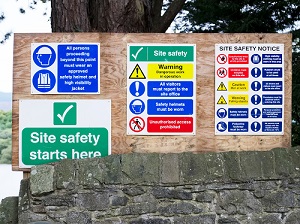
All safety signs should remain visible, unobstructed, and fully legible. If a sign becomes vandalized, rusted, faded, damaged, or begins peeling away from its mounting surface, it must be replaced immediately. If a sign is no longer accurate or relevant, it must be removed or covered right away to prevent confusion.
OSHA Standard 1926.200(a) Signs required shall be visible at all times when work is being performed, and shall be removed or covered promptly when the hazards no longer exist.
Consistent, correct use of safety signs is essential. Signs communicate with workers long before a supervisor or competent person has the chance to by helping prevent injuries, controlling traffic, guiding pedestrian movement, and alerting people to hazards they may not be aware of.
Danger Signs
Danger signs signal the highest level of hazard. These signs indicate an immediate threat where special precautions are required. When a risk is severe enough that it could cause serious injury or death, a Danger sign must be used.
Red should be the predominant color on a black-and-white Danger sign.
OSHA Standard 1926.200(b)(1-2) Danger signs shall be used only where an immediate hazard exists… Danger signs shall have red as the predominating color for the upper panel; black outline on the borders; and a white lower panel for additional sign wording.
Workers should never assume that “everybody already knows” about a high-risk hazard. Danger signs must be posted at the exact point of danger to prevent serious injury to employees, subcontractors, inspectors, delivery drivers, and anyone else who may pass through the area.
Caution Signs
Caution signs warn against potential hazards or unsafe practices that could result in minor or moderate injuries if not avoided. They are used when a situation is not immediately life-threatening, but still requires awareness and care.
Caution signs are yellow and black for high visibility.
OSHA Standard 1926.300(b)(2) Caution signs shall be used only to warn against potential hazards or to caution against unsafe practices… Caution signs shall have yellow as the predominating color; black upper panel and borders: yellow lettering of "caution" on the black panel; and the lower yellow panel for additional sign wording. Black lettering shall be used for additional wording.
Examples of cautions signs include “Slippery When Wet,” “Watch Your Step,” or “Hearing Protection Required.”
Warning Signs
Warning signs indicate a hazard level between Caution and Danger. These signs signal a potentially hazardous situation that could cause serious injury if not avoided, but is not considered immediately life-threatening.
Warning signs typically use the color orange with black lettering.
Common examples of warning signs include warnings for energized equipment, suspended loads, or partial demolition work.
Instruction Signs
Safety instruction signs provide information, procedures, or reminders intended to promote safe behavior. These signs often indicate what workers should do rather than what they should avoid.
OSHA Standard 1926.200(e) Safety instruction signs, when used, shall be white with green upper panel with white letters to convey the principal message. Any additional wording on the sign shall be black letters on the white background.
Examples of instruction signs in a workplace or on a jobsite include “First Aid Station,” “Emergency Shower,” or “Safety Glasses Available Inside.”
Instruction signs help guide workers toward safe practices and help identify safety equipment or emergency resources on the jobsite.
Notice Signs
Notice signs communicate general information that is important but not directly related to a specific hazard. They are often blue and white and provide direction or clarification for workplace expectations, security procedures, hygiene rules, or facility logistics.
Examples of notices signs include “Authorized Personnel Only,” “Keep This Door Closed,” or “Handwashing Required.”
Best Practices for Safety Signs
To make safety signage as effective as possible:
- Keep signs clean and unobstructed. Dust, paint overspray, or stacked materials can make signs invisible.
- Position signs at eye level whenever possible. Placement affects visibility and comprehension.
- Use universally understood symbols. Icons help communicate quickly, especially for workers with limited English proficiency.
- Post signs before exposure to hazards begins. Signs must be installed ahead of the work, not after workers are already exposed.
- Ensure adequate lighting. Signs must be visible day and night, indoors or outdoors.
- Train employees on what signs mean. A sign is only effective when workers understand the message.
Safety signs are more than a formality, they are a critical part of your workplace hazard communication system. When used correctly, they help prevent injuries, guide safe behavior, and maintain compliance with OSHA requirements.
.jpg)

