Confined spaces can contain atmospheric hazards that workers cannot see or smell. Oxygen levels may be unsafe, flammable gases or vapors may be present, or toxic gases may accumulate. Portable gas monitors provide critical information about these hazards before workers enter a confined space and while work is underway.
.jpg)
Using a gas monitor, however, involves more than turning it on and looking at the display. The monitor must have the right sensors for the hazards that could be present, it must be working properly, and atmospheric testing must be performed correctly. Conditions inside a confined space can also change during the job, making continued monitoring an important part of confined space safety.
OSHA General Industry Standard 1910.146(d)(5)(i) Test conditions in the permit space to determine if acceptable entry conditions exist before entry is authorized to begin, and if entry is authorized, entry conditions shall be continuously monitored in the areas where authorized entrants are working.
For permit-required confined spaces, OSHA requires employers to evaluate hazards before employees enter and to provide the testing and monitoring equipment needed for safe entry.
Using a Portable Gas Monitor
A portable gas monitor is a direct-reading instrument that measures specific atmospheric conditions based on the sensors installed in the device. A common four-gas monitor typically measures oxygen, combustible gases and vapors, carbon monoxide, and hydrogen sulfide.
Combustible gases and vapors are commonly displayed as a percentage of the lower explosive limit, or %LEL. The lower explosive limit is the lowest concentration of a gas or vapor in air that can support combustion when an ignition source is present.
One of the most important limitations to understand is that a gas monitor does not detect every possible atmospheric hazard. It detects only the hazards its installed sensors are designed to detect. A standard four-gas monitor should never be assumed to detect another toxic gas simply because it is capable of detecting carbon monoxide or hydrogen sulfide.
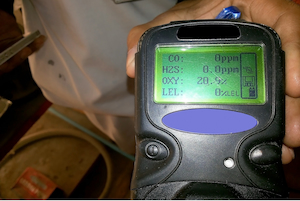
Before using a portable gas monitor, workers should understand:
- Which gases the monitor detects
- What the readings on the display mean
- What the alarm settings and warning indicators mean
- How the monitor should be worn or positioned
- What action is required if an alarm activates
NIOSH has also emphasized the importance of knowing the specific equipment being used and being able to correctly interpret multi-gas monitor readings.
Test Atmosphere Before Entry
Atmospheric testing should begin before a worker enters a confined space where an atmospheric hazard could be present. When feasible, the atmosphere should be tested from outside the space so that a worker does not have to enter an unknown atmosphere to obtain the initial readings.
OSHA Construction Standard 1926.1204(e)(3) and General Industry Standard 1910.146(d)(5)(iii) When testing for atmospheric hazards, test first for oxygen, then for combustible gases and vapors, and then for toxic gases and vapors.
For permit-required confined spaces in construction, OSHA requires testing to determine whether acceptable entry conditions exist before entry is authorized. OSHA specifies the following order when testing for atmospheric hazards:
- Oxygen
- Combustible gases and vapors
- Toxic gases and vapors
This sequence matters. Oxygen is tested first because some combustible-gas sensors depend on sufficient oxygen to provide reliable readings. Combustible gases and vapors are tested next because of the potential fire and explosion hazard. Toxic gases and vapors are then tested.
OSHA Construction Standard 1926.1204(e)(1) Test conditions in the permit space to determine if acceptable entry conditions exist before changes to the space's natural ventilation are made, and before entry is authorized to begin.
An acceptable reading at the entrance does not mean the entire confined space has an acceptable atmosphere. Atmospheric conditions may be different farther inside the space, and they may vary at different heights or depths.
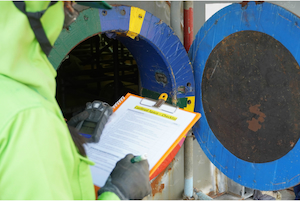
Test All Areas of Confined Space
Gases and vapors can accumulate in different areas of a confined space, creating a stratified atmosphere. A reading taken in one location may therefore be very different from a reading taken somewhere else in the same space.
When necessary, a sampling probe, tubing, or another approved method can be used to test areas before a worker physically enters them. Testing should proceed in the direction the worker will travel.
When sampling tubing or a remote probe is attached to a portable gas monitor, the reading on the instrument may not immediately represent the atmosphere at the end of the tubing.
The manufacturer's specified response time must be considered. Air from the sampling location needs time to travel through the tubing to the sensors, and the monitor then needs time to respond. Moving the probe too quickly from one location to another can result in readings that do not accurately represent each sampling location.
OSHA General Industry Standard 1910.146(d)(5)(ii) Test or monitor the permit space as necessary to determine if acceptable entry conditions are being maintained during the course of entry operations.
For vertical entries where atmospheric stratification may occur, OSHA guidance recommends testing the atmospheric envelope approximately every four feet in the direction of travel and to each side.
Bump Tests and Calibration Checks
A portable gas monitor is only useful when it is functioning properly and producing reliable information. Before relying on a monitor, check its battery level and inspect it for damage, fault messages, blocked sensor openings, or other problems that could interfere with operation. Always follow the manufacturer's instructions for operation, testing, calibration, charging, maintenance, and sensor replacement.
OSHA guidance recommends performing a bump test or calibration check before each day's use in accordance with the manufacturer's instructions.
Although the terms are sometimes confused, a bump test and a calibration check serve different purposes.
What Is a Bump Test?
A bump test, sometimes called a function check, exposes the monitor's sensors to a challenge gas in order to verify that gas reaches the sensors and that the instrument's alarms activate.
A bump test is a functional test. It does not verify the accuracy of the numerical measurement displayed by the monitor.
What Is a Calibration Check?
A calibration check exposes the monitor to a known concentration of test gas. The monitor's reading is compared with the concentration of the test gas to determine whether the instrument is reading within the manufacturer's acceptable range.
A full calibration is different because it actually adjusts the instrument's reading to correspond with a known concentration of test gas.
If a monitor fails a bump test or calibration check, OSHA guidance states that it should receive a full calibration before use. If the instrument cannot be successfully calibrated, it should be removed from service.
Continuous Gas Monitoring
A confined space that has acceptable atmospheric conditions at the beginning of a job may not remain that way.
Work activities can introduce new hazards or change the atmosphere. Welding and cutting can affect atmospheric conditions. Chemicals and coatings may release vapors. Equipment can leak, nearby operations can introduce contaminants, organic material can decompose, and changes in ventilation can affect contaminant concentrations or oxygen levels.
This is why pre-entry testing should not be treated as proof that the atmosphere will remain safe for the rest of the job.
OSHA Construction Standard 1926.1204(e)(1)(ii) If [confined space] entry is authorized, continuously monitor entry conditions in the areas where authorized entrants are working.
For permit-required confined spaces, OSHA requires continuous monitoring of atmospheric hazards unless the employer can demonstrate that equipment for continuously monitoring a particular hazard is not commercially available or that periodic monitoring is sufficient to ensure the hazard remains controlled at safe levels. If continuous monitoring is not used, OSHA requires periodic monitoring frequently enough to ensure acceptable entry conditions are maintained.
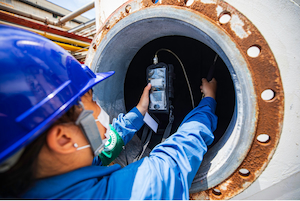
Wearing a Portable Gas Monitor
When a portable gas monitor is being used for personal monitoring, it should be worn in the worker's breathing zone, with the sensor openings unobstructed.
The exact placement and use of a particular monitor should follow the manufacturer's instructions. Clothing, equipment, dirt, or other materials should not cover or block the sensor openings.
Workers should also avoid treating the monitor as something to check only occasionally. When it is being used for continuous personal monitoring, it needs to remain positioned so it can sample the atmosphere as intended.
Gas Monitor Alarms
A portable gas monitor alarm is a warning that requires action. It should never be ignored simply because the worker cannot see or smell anything unusual.
If an alarm or monitor reading indicates that acceptable entry conditions are no longer being maintained, workers should leave the confined space as required by the entry procedures. The alarm should not simply be silenced so work can continue. Workers should not re-enter until the hazard has been evaluated and the conditions required for safe entry have been restored.
The absence of an odor is not evidence that an atmosphere is safe. Carbon monoxide, for example, is colorless and odorless. Some hazardous gases can also interfere with a person's ability to rely on smell as a warning. For that reason, decisions about atmospheric safety should be based on appropriate testing and monitoring rather than the senses.
Portable Gas Monitor Mistakes
Many gas-monitoring problems are not caused by the absence of a monitor but by relying on the instrument incorrectly. Common mistakes to avoid include:
- Assuming a four-gas monitor detects every atmospheric hazard
- Entering an unknown atmosphere before performing required pre-entry testing
- Testing only at the opening and assuming the reading represents the entire space
- Moving a remote sampling probe before allowing enough time for the monitor to respond
- Using a monitor that has not been properly tested or maintained
- Blocking the monitor's sensor openings with clothing or equipment
- Assuming an acceptable pre-entry reading means conditions cannot change
- Ignoring, silencing, or working through an alarm
Portable gas monitors are valuable safety tools, but they do not make a confined space safe by themselves. The information they provide must be interpreted correctly and used as part of the employer's overall confined space entry procedures.
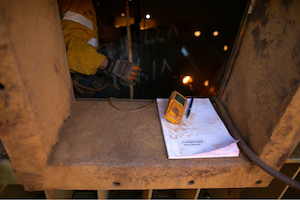
Portable Gas Monitor Safety
Effective atmospheric monitoring begins with selecting the correct instrument for the hazards that could reasonably be present. Workers need to know what their monitor detects, understand its readings and alarms, and make sure it is functioning properly before relying on it.
Testing should begin before entry and include the areas workers will encounter. Once work begins, atmospheric conditions must continue to be monitored as required because the environment inside a confined space can change.
Most importantly, never ignore a portable gas monitor alarm. Stop, follow the established entry procedures, and leave the space when monitoring indicates that acceptable entry conditions are no longer being maintained. A gas monitor can provide an early warning of a dangerous atmosphere, but that warning only protects workers when it is understood and acted upon.
.jpg)

.jpeg)